One of the ugliest chapters of American history, the Salem witch trails of 1692, affected a number of our ancestors.

According to an insightful book on the subject, The Devil Discovered: Salem Witchcraft 1692, by Enders A. Robinson, the witch hunt “was driven by conspiracies of envious men [namely, the extended family of Thomas Putnam] intent on destroying their enemies. The maneuvers were sanctioned by the old guard of Puritan leaders acting in tacit collusion.” The consequences were widespread and deadly.
Some of the affected members of our ancestral family were:
• Samuel Wardwell (1643-1692): My wife’s first cousin, 10 times removed.
A carpenter by trade, Samuel Wardwell is reputed to have worked on the house of John Turner, built in 1668-1669 in Salem. The house, with its angular structure, was made famous by Nathaniel Hawthorne in his House of the Seven Gables.
Samuel Wardwell was married, had seven children with his wife, and was 49 years old when he was executed.
He was one of the eight people hanged on 22 September 1692 in Salem.
From The Devil Discovered:
“On the day of execution, Thursday, Lecture Day, September 22, 1692, the eight, Martha Corey, Mary Easty, Alice Parker, Ann Pudeator, Margaret Scott, Wilmot Redd, Mary Parker, and Samuel Wardwell, like the others before them, were loaded onto a cart. The local taverns were filled with people awaiting the executions, and a huge throng lined the streets despite the rain. Some had traveled from far; more had come from nearby towns. Many children stood with their parents. No one was discouraged from attending, for an execution was regarded as a deterrent to sin. When the cart reached the outskirts of the town, it turned aside from the main road and began to ascend Gallows Hill. With its dark slope and the even line of its summit, the hill resembled a green rampart, its rocky soil covered by scraggly underbrush.
“The cart became stuck going uphill, mired in a muddy rut. The horses strained under the whip, trying to free it. The afflicted girls, following immediately behind in another cart, chorused, ‘The Devil hinders the cart! The Devil hinders the cart!’ With their spectral sight, they saw the Black Man struggling against the horses, vainly attempting to pull back the cart, to stop them from taking his eight witches to the hanging tree. But the path was less steep than it appeared, and the horses soon managed to pull the cart to the top of Gallows Hill. There, spreading its branches towards heaven like a lone sentinel stood the great locust tree.
“At his execution, Samuel Wardwell, a carpenter, addressed the people with the truth, saying that he was innocent, as were the others who were convicted. As he spoke, the executioner stood beside him, casually smoking a pipe of Virginia tobacco. The smoke blew into Wardwell’s face, choking him and interrupting his speech. Watching from the front row, the afflicted girls saw, in their invisible world, the Devil. To stop Wardwell from speaking, the Devil was directing the hot vapors of hellfire into Wardwell’s face to choke him. ‘The Devil hinders Wardwell with smoke! The Devil hinders Wardwell with smoke!’ chanted the girls.
“Afterwards, the Rev. Nicholas Noyes pointed to the locust tree, with its broad branches holding their heavy burden. Turning to the crowd, he cried, ‘What a sad thing it is to see eight firebrands of hell hanging there.’” And sadder still when, in truth, all eight were innocent. The Rev. Noyes, a corpulent man who enjoyed eating, partook of a leisurely noon meal with friends. Refreshed, then he delivered his Lecture Day sermon at the meetinghouse.”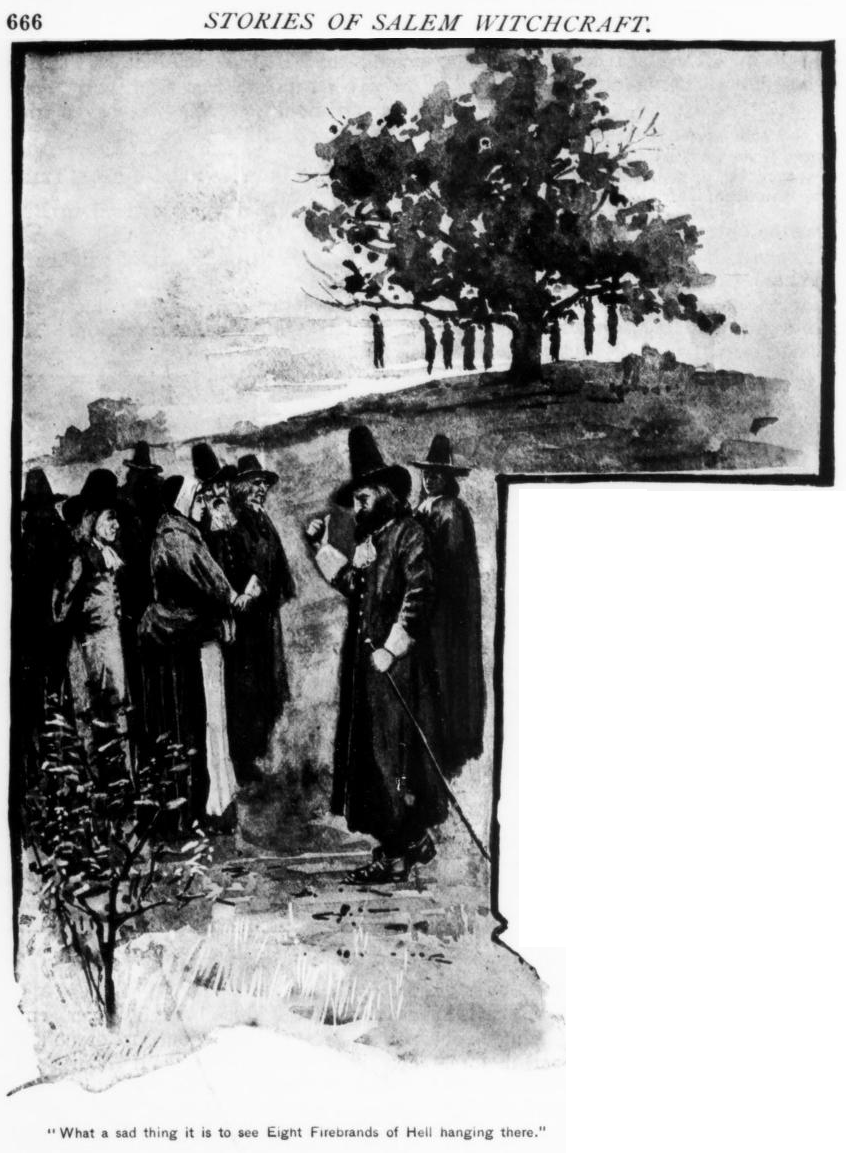
• Robert Lord, III (1657-1735): My wife’s 7th great-grandfather.
A blacksmith by trade and a resident of nearby Ipswich, Robert Lord was contracted to make handcuffs and fetters and attach them to four prisoners in the Ipswich prison, the evidence of which we have in the bill he submitted for his services. The Salem prison was overflowing with people accused of witchcraft, so neighboring prisons, including the one in Ipswich, were enlisted to help contain the accused.
One of the women Lord made and attached handcuffs and fetters to was Mary Easty, who was hanged at the same time as Samuel Wardwell on September 22, 1692. Another was Mary’s sister Sarah Cloyce, whose husband had formerly been married to Hannah Littlefield, and Sarah was helping raise Hannah’s children. [Hannah Littlefield was my wife’s eighth great-grandaunt.]
These two women, in their 50s, were accused of being witches by Thomas Putnam and his associates because they were married to men who were directly or indirectly in land disputes with the Putnam family.
From The Devil Discovered:
“In mid- June [1692] Mary Easty and Sarah Cloyce were transferred from the Boston prison to the Ipswich prison. An account of Robert Lord, blacksmith of Ipswich from about July 31 reads, ‘For making four pairs of iron fetters and two pairs of handcuffs and putting them on to the legs and hands of Goodwife Cloyce, Easty, Brumidge, and Green. £1.12.0.’ ”
• John Littlefield (1624-1697): My wife’s eighth great-granduncle
John Littlefield was a resident of Wells, Maine, which was one of the most northerly outposts of New England and which came under frequent Indian attacks in the French-Indian wars. Two of my wife’s ancestral families, the Littlefields and Wardwells, were among the first settlers of the area in the 1600s. Some of the Littlefield homes became ‘garrison’ homes during Indian raids: places which were better fortified and where townfolk gathered to protect themselves.
Captain John Littlefield was dispatched to Boston in 1691 to deliver a request written by his friend the town’s minister, George Burroughs, for more soldiers to repel the Indian attacks and protect the townfolk. When a party of soldiers arrived later that year, the townspeople were relieved . . . only to find that they had not come to protect the village but to arrest its minister as a witch.
From The Devil Discovered:
“Once again, on September 28, 1691, with the embattled garrisons surrounded by Indians, Burroughs appealed to the Council in Boston. A young man, venturing forth less than a hundred feet outside the garrison to fetch some firewood, had been captured by the stealthy Indians. Burroughs writes, ‘Whereas it has pleased God, to let loose the heathen upon us, keeping us in close garrison, and daily lying in wait to take any that go forth, whereby we are brought very low, not all the corn is judged enough to keep the inhabitants themselves one half year. We therefore humbly request your honors to continue soldiers among us to remain with us for winter. We had a youth, seventeen years of age, last Saturday carried away, who went (not above gunshot) from Lieut. Storer’s garrison to fetch a little wood in his arms. We have desired our loving friends, Captain John Littlefield and Ensign John Hill, to present this to your honors.’
“On May 2, 1692, for a brief moment, the people of Wells thought that the aid they had so long hoped and prayed for finally had arrived. On that day Field Marshal John Partridge rode into Storer’s garrison with a few men. But instead of carrying good news of reinforcements, Partridge carried an arrest warrant. To the astonishment of his parishioners and comrades, the Rev. George Burroughs, the garrison’s bastion of strength, a true minister of God, was arrested for witchcraft; the afflicted girls of Salem Village were claiming that ‘he was above a witch, for he was a conjurer.’ At the precise point when he was most needed, Burroughs was taken captive and carried from Wells to Salem prison to stand trial for his life.
“Two months later, on August 10, 1692, the Rev. George Burroughs, age forty-one, was hanged in Salem.”
Many of the historical events that seem remote and immaterial to us today greatly affected those who lived through them, including our forefathers and mothers. The Salem witch trials and executions were gruesome examples of the dark side of human nature, in which one person’s or a group’s hatreds, jealousies, and vengeance, when left unchecked, caused widespread pain and death.
In our modern era it may be appropriate to recognize September 22nd as Witch’s Day, an appropriate start to the Halloween season, and a time to reflect on the trials of our ancestor’s difficult lives . . . and how best to light our own dark times through warmth, compassion, tolerance, and rationality.